The Last Humans Standing: A Field Guide to Surviving the Robot Uprising
There is a particular flavor of dread reserved for white-collar workers in 2026, and it goes something like this: you spend fifteen years perfecting the art of summarizing quarterly reports, drafting polite emails that say nothing, and building spreadsheets nobody reads, only to discover that a language model can now do all three before your coffee gets cold. Meanwhile, the plumber who fixed your geyser last Tuesday is booked solid until October and just bought a bakkie with cash.
Welcome to the great inversion. For decades, we told our children that the safe path was "get a degree, sit in an office, avoid manual labor." It turns out AI took that advice far more literally than we did, and it is now extremely good at everything we called "knowledge work" and hilariously bad at everything we called "unskilled labor." The bricklayer is safe. The junior analyst is not. Somewhere, a career counselor from 1997 is quietly weeping.
Based on a recent capability-filtered reassessment of South Africa's high-demand occupations list, roughly 40% of what used to count as secure employment has been reclassified as "highly applicable to AI," which is bureaucratic for "you're on your own, champ." The other 60% survives, and the survivors form a rather amusing club. Let's meet them.
The Aristocracy of Getting Their Hands Dirty
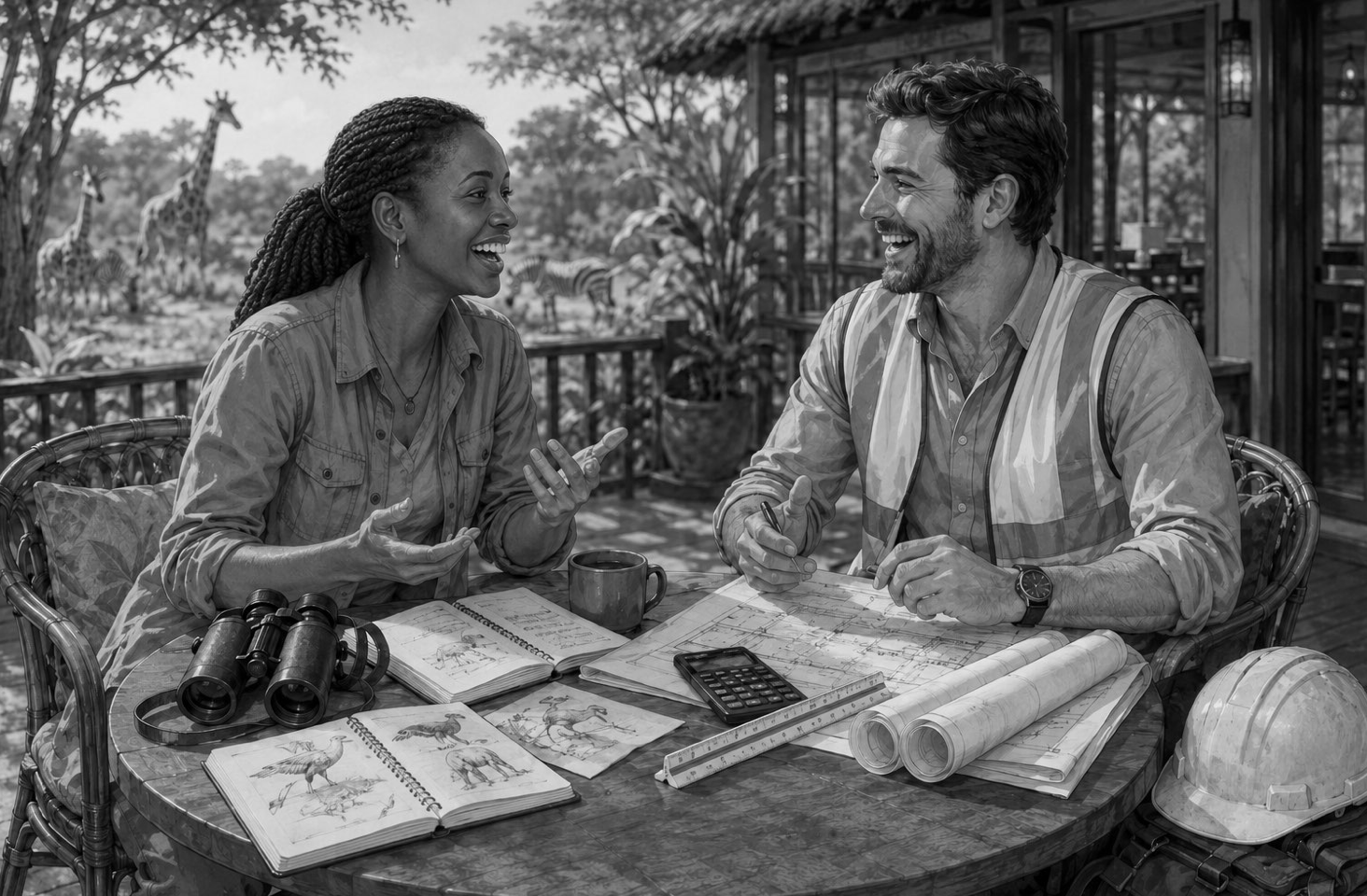
At the top of the new social hierarchy sit the people AI cannot touch because their job requires touching things. Electricians, plumbers, zoologists, quantity surveyors, welders, boilermakers, diesel mechanics — the entire fellowship of people who own more tools than furniture. Their moat isn't intelligence, it's dexterity in chaos. Every geyser leaks differently. Every engine fails in its own creative way. No robot has yet been built that can crawl under a 1998 Toyota in the rain and diagnose a problem by smell, and until one is, the millwright remains economically untouchable.
There is something deliciously ironic about this. The people who were told throughout school that they were "not academic enough" for university are about to become the last aristocracy of the labor market, while the people who got distinctions in Business Management are filing unemployment claims next to a chatbot that took their job and didn't even feel bad about it.
The Priesthood of Trust
Then there are the professions that survive not because AI lacks the technical capability, but because we, the humans, refuse to let a machine hold the moral weight. Nobody wants to hear "you have twelve months to live" from a language model, even a very empathetic one with excellent bedside manner tuning. Doctors, nurses, midwives, clinical psychologists, and social workers occupy this category. AI can read the scan faster and more accurately than any radiologist alive. It still cannot hold your hand while you cry about the scan, and it turns out that's the part we were actually paying for.
This is the great humbling lesson of the AI era: technical competence was never the scarce resource. Trust was. And trust, annoyingly for the shareholders, cannot be trained on a dataset. It has to be earned by a person who can be sued, fired, or disappointed in you personally.
The Guild of People Who Can Be Blamed
Adjacent to the trust economy is the accountability economy, populated by attorneys, adjudicators, engineers who sign off on bridges, and quality managers who put their name on things. These roles survive for a reason that is almost comically bureaucratic: someone has to be legally and professionally liable when things go wrong, and "the algorithm did it" is not currently an acceptable answer in a court of law or a structural collapse inquiry. AI can draft the engineering calculations. It cannot go to prison. Until it can, the person with the professional registration number stays employed, mostly as a very expensive insurance policy with a pulse.
Future historians will note the strange dignity of this arrangement: entire careers preserved not by irreplaceable brilliance but by the simple fact that someone needs a neck to put in a noose if the building falls down.
The Court Jesters of Embodied Charm
Hairdressers, chefs, tour guides, flight attendants, nail technicians, waiters. This category survives on a beautifully petty human weakness: we like being fussed over by other people. You could, in theory, get a robot to cut your hair. Nobody wants that. The entire point of a haircut is the twenty minutes of gossip, mild flattery, and someone telling you your fringe will "definitely grow out nicely." AI can generate a passable haircut tutorial. It cannot generate the specific pleasure of a human being who remembers you take your coffee with low fat milk.
The hospitality sector, in other words, survives because humans are emotionally needy in ways that spreadsheets never anticipated. This is either deeply reassuring or deeply embarrassing, depending on your mood.
The Reluctant Firefighters of Reality
Field technicians, mining engineers, geologists, environmental scientists — the people whose entire job is going outside and looking at things that refuse to behave the way the model predicted. Rock formations don't read training data. Rivers don't follow the spreadsheet. Every mine shaft, every water table, every collapsed retaining wall is a slightly different flavor of "the map is not the territory," and someone in steel-toed boots has to go find out why reality disagreed with the forecast. AI is magnificent at prediction and catastrophic at showing up.
The Shepherds of Small Humans
Teachers, early childhood practitioners, sports coaches, and school principals also survive, for reasons that should be obvious to anyone who has ever tried to get a seven-year-old to sit still. Education was never really about information transfer — if it were, Wikipedia would have replaced schools a decade ago. It's about a human noticing that a particular child is having a bad week and adjusting accordingly. AI tutors can drill multiplication tables beautifully. They cannot notice that Thabo has been unusually quiet since his parents' divorce and gently check in. This is not a technical limitation that will be solved with more compute. It's a limitation of not being a person who cares about a specific other person.
The Departed: A Brief Moment of Silence
We should pause respectfully for the fallen. Rest in peace to the routine data analyst, the standard bookkeeper, the call-centre agent whose entire job was reading a script slightly more patiently than the last person, the translator who converted PDF menus, and the digital content producer who existed solely to write blog posts titled "10 Tips for Productivity." These roles did not disappear because the humans doing them were incompetent. They disappeared because the work itself was, in retrospect, always just information rearrangement wearing a job title as a costume. AI didn't so much take these jobs as reveal that they were never as human as we pretended.
This is the uncomfortable punchline of the whole affair: it was never about intelligence. It was about which jobs required a body, a license, a relationship, or a neck to hold accountable. The clerk with a master's degree got automated. The plumber with a National Certificate did not. Somewhere, every parent who told their child to avoid the trades is quietly recalculating.
The Moral, Delivered With Minimal Smugness
The satire here writes itself, but the underlying lesson is not actually funny: the future belongs to people who can be trusted, touched, sued, or hugged, not necessarily to people who scored well on standardized tests. If you want job security in the AI era, the winning strategy is apparently to become the kind of person a machine cannot impersonate convincingly enough to be sued in your place, or trusted in your place, or missed at a funeral in your place.
So take some comfort, electricians, nurses, teachers, and welders of the world. Your moment has arrived, and it arrived not because you're smarter than the machine, but because you're accountable, embodied, and occasionally capable of a decent bedside manner. The bots have inherited the spreadsheets. You've inherited everything that actually mattered.